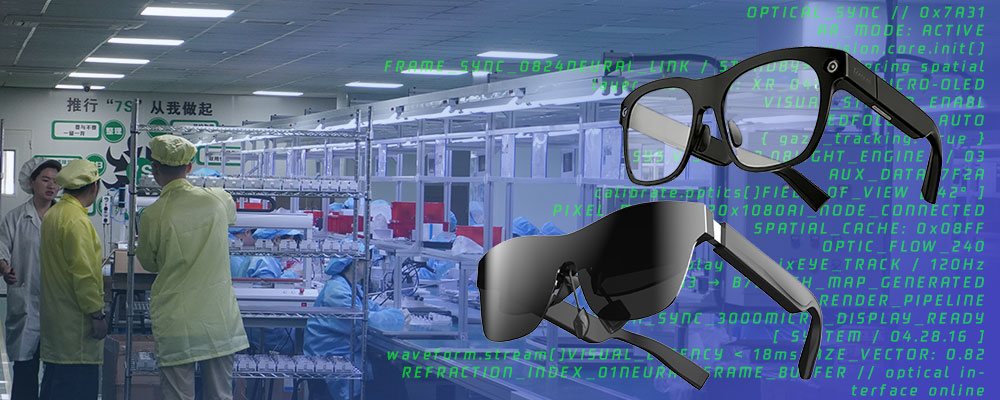
Developing smart glasses involves several disciplines, including industrial design, electronics, optics, mechanical engineering, software, manufacturing, and quality management. For brands developing AI smart glasses, AR smart glasses, and other smart wearable devices, the main challenge is not just implementing the required features. It also means turning a product concept into a mature product that fits comfortably, performs reliably, and can be produced consistently at scale.
Compared with traditional consumer electronics, smart glasses have much more limited internal space. This requires careful trade-offs between weight, size, power consumption, heat dissipation, and wearing comfort. AI smart glasses typically focus on cameras, audio, wireless connectivity, and computing capabilities, while AR smart glasses may also incorporate display modules, optical systems, and spatial sensing. Product development must therefore integrate industrial design, engineering, prototype validation, and manufacturing from the early stages, ensuring the product not only meets functional requirements but is also manufacturable and ready for mass production.
The first step in smart glasses development is to define the product's positioning, target users, and primary use cases. Brands need to determine whether the product is AI smart glasses, AR display glasses, or a wearable device that combines multiple functions. These decisions then guide requirements for features, wearing style, and target markets. For example, AR glasses designed for home entertainment differ significantly from AI cycling glasses intended for outdoor training in terms of feature sets, structural design, and operating environments.
Once the product direction is established, the requirements need to be translated into specific specifications, including overall dimensions, weight, battery life, camera configuration, audio, connectivity, and display solutions. For AI smart glasses, it is also necessary to determine whether AI processing will take place primarily on the device or in the cloud, as this affects the processor, memory, power consumption, and network connectivity requirements.
Technical feasibility should be evaluated alongside product definition. The limited internal space of smart glasses means that increasing battery capacity may affect temple size and weight, improving camera performance may increase power consumption and heat dissipation demands, and adding a display system may require greater precision in optical alignment and mechanical design. Early development should therefore also assess costs, the availability of key components, manufacturing processes, and certification requirements in target markets. Where technical uncertainties exist, proof-of-concept testing and functional prototypes can help validate the proposed approach early and reduce downstream development risks. Involving R&D, engineering, and manufacturing teams from the outset helps identify potential issues before design freeze and reduces the need for later modifications.
Industrial design determines not only the appearance of smart glasses but also their wearing comfort and internal layout. Frame dimensions, temple design, nose pads, weight distribution, and center of gravity must all be considered in relation to everyday use. For products incorporating batteries, cameras, speakers, or display modules, the internal layout must also account for ergonomics.
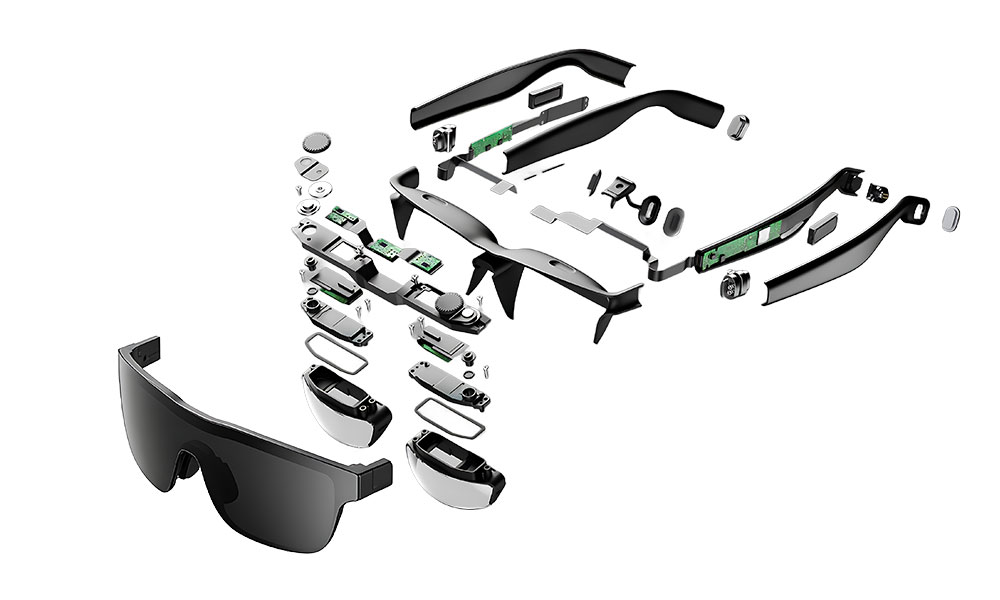
Once the industrial design is established, mechanical engineering translates the exterior concept into a manufacturable and assemblable product structure. Components such as the main PCB, battery, cameras, speakers, microphones, and antennas must be arranged efficiently within the limited internal space, with sufficient room for connections, mounting, insulation, and heat dissipation. AI smart glasses typically need to integrate multiple electronic components into slim temples, while AR smart glasses place greater demands on the positioning and structural precision of display and optical systems.
Materials and manufacturing processes should also be considered during the design stage. Plastic injection molding, metal machining, and surface finishing affect product weight, appearance, dimensional stability, and cost. For injection-molded parts, wall thickness, draft angles, ribs, snap-fit features, and the risk of sink marks and warpage should be evaluated in advance. Identifying issues through structural reviews, rapid prototyping, and assembly validation before formal tooling begins can reduce subsequent mold modifications and engineering changes. For ODM smart wearable projects that extend from R&D into manufacturing, mechanical design must also account for injection molding, assembly, and quality control requirements to improve manufacturability.
The electronics architecture should be defined according to the product's functions, including the main processing platform, sensors, cameras, communication modules, power management, and peripheral circuits. AI smart glasses typically integrate a processor, cameras, microphones, speakers, Bluetooth, and Wi-Fi modules. AR smart glasses may also require display drivers, an IMU, and other sensors. PCBA design must proceed in parallel with mechanical development to ensure that the PCB outline, component placement, and connector positions fit the limited internal space while meeting requirements for high-speed signals, power integrity, RF performance, and electromagnetic interference.
Power consumption and heat dissipation are important hardware development considerations. Cameras, wireless communication, audio, and computing tasks may operate simultaneously, so the power architecture must be optimized for different operating modes. Heat generated by the processor and wireless modules must be managed through appropriate hardware placement, structural materials, and thermal paths. Because electronic components are located close to the user's face, temperature rise can also directly affect wearing comfort. In addition, the battery, metal components, and overall mechanical structure can all influence antenna performance, making early validation of wireless connectivity and RF performance essential.
The mechanical design, electronics, and manufacturing processes of highly integrated smart glasses are closely interdependent. If PCBA, mechanical components, assembly, and mass production are handled separately by different teams or suppliers rather than managed throughout by a one-stop ODM R&D and manufacturing service provider, the project must coordinate more engineering interfaces. Maintaining continuity of information between R&D, engineering, and manufacturing helps reduce repeated adjustments between design and production and improves the transition from development to mass production.
Prototyping is a key link between the product concept and engineering development. Early prototypes are primarily used to validate appearance, dimensions, wearing comfort, and ergonomics. Rapid manufacturing methods such as 3D printing and CNC machining can be used to produce them. Functional prototypes focus on validating the hardware architecture and core functions. Depending on project requirements, they may integrate development boards, custom PCBAs, existing modules, and rapidly manufactured structural components.
Testing typically covers system startup, wireless connectivity, audio, cameras, power management, and core software functions. AI smart glasses require particular attention to voice interaction, image capture, and data transmission. AR smart glasses also require validation of the display, optics, sensors, and hardware-software integration.
As the product matures, prototypes should progressively reflect the intended production structure and hardware configuration. Full-system testing should then be conducted, with particular attention to power consumption, temperature rise, assembly, connection reliability, and stability under actual operating conditions. When prototype development is coordinated with subsequent tooling and production processes, structural assembly issues, electronic integration problems, and manufacturability concerns can be identified before formal tooling begins. This provides a basis for engineering validation and mass-production preparation.
It is important to note that rapid prototypes cannot replace mass-production validation. The materials, manufacturing methods, and assembly conditions used for prototypes may differ from those used in production. Their primary purpose is to validate the design direction, identify risks, and support optimization, rather than to prove that the product is ready for large-scale manufacturing.
Once the main design approach has been established, the project enters a systematic engineering validation phase to confirm that the product meets its specified requirements and to assess its stability and reliability under actual operating conditions. Test items should be determined according to the product type and intended use cases. They typically include overall functionality, power consumption, temperature rise, structural strength, drop resistance, vibration, connection reliability, and relevant environmental tests. Products with dust and water resistance requirements also need to undergo appropriate testing for their target protection ratings.
Cameras, displays, and audio systems require dedicated testing as well. AR products, in particular, need careful evaluation of display and optical performance, along with assembly consistency between optical components. Wear-prone parts, such as hinges, temple joints, buttons, and charging interfaces, should undergo durability testing to assess their reliability over extended use.
When problems are identified, their root causes should be traced to design, components, materials, software, or manufacturing processes, and appropriate corrective actions should be taken. Changes involving the PCB, mechanical dimensions, critical components, or materials must be assessed for their impact on other systems and verified through the necessary testing. Products intended for different international markets should also account for relevant certification requirements, including those related to wireless communications, electrical safety, batteries, and environmental regulations.
Engineering validation must also take manufacturing into account. Changes to structural dimensions, materials, and connection methods can affect tooling, assembly, and production testing. Design changes should therefore be assessed for their impact on subsequent manufacturing processes to avoid major adjustments during mass-production preparation.
Once the product design has reached a sufficient level of maturity, tooling development and manufacturing process planning become important parts of mass-production preparation. For smart glasses with injection-molded housings, a DFM (Design for Manufacturability) review should be conducted before formal tooling begins. Key considerations include wall thickness, draft angles, parting lines, snap-fit features, ribs, and potential sink marks and warpage. Cosmetic parts also require consideration of gate locations, ejection methods, surface textures, and cosmetic defect control to ensure that injection-molded parts meet subsequent assembly requirements.
Once the molds are completed, trial molding should be used to evaluate part quality. Mold designs or molding parameters can then be adjusted based on dimensional accuracy, appearance, and assembly results. Products involving metal machining, surface finishing, precision bonding, and optical components also require validation of the relevant processes.
Manufacturing process development should not wait until the molds are completed. Processes such as injection molding, PCBA production, electronic testing, final assembly, and packaging need to be planned. The product structure should determine the necessary fixtures, test equipment, and workstation configurations. With an integrated manufacturing service model covering R&D, tooling, injection molding, PCBA, and final assembly, these stages can progress continuously within a single project workflow. This helps keep mechanical design, tooling development, and production processes aligned while reducing repeated adjustments later.
Pilot production is an important transition from engineering development to large-scale manufacturing. Wherever possible, pilot runs should use production tooling, mass-production materials, actual manufacturing equipment, and the planned process flow to verify that the manufacturing system can operate consistently. Key areas to check include injection molding, PCBA production, final assembly, firmware programming, functional testing, and final inspection, ensuring that they form a stable production workflow.
Clear work instructions and quality standards must be established for critical processes. For processes that are sensitive to parameter variations or prone to operator-dependent inconsistencies, dedicated fixtures, error-proofing measures, or automated test equipment can be introduced as needed to improve production consistency. Test coverage should correspond to the product's functions and include relevant PCBA, camera, audio, wireless communication, charging, power management, sensor, and display functions. Test results should be recorded. Products that support software or firmware upgrades also require appropriate version control and programming procedures.
Defects identified during pilot production should be classified according to the process in which they occur and their root causes, distinguishing between design issues, component defects, process problems, and operational errors. Recurring problems must be addressed through engineering analysis and corrective action rather than relying solely on final inspection to screen out defective units. Pilot production can also be used to validate the supply chain, production cycle time, testing capabilities, and quality standards. The product should proceed to formal mass production only after critical design issues have been resolved, production processes have become reasonably stable, and testing and quality control procedures can be consistently implemented.
Once mass production begins, the primary objective shifts from determining whether the product can be manufactured to ensuring that it can be manufactured consistently over time. Quality control must cover incoming materials, in-process production, and finished-product shipment. Incoming inspection requirements should be established for key electronic components, cameras, display modules, batteries, and sensors according to their functions and quality risks. Mechanical components require attention to critical dimensions, appearance, materials, and assembly fit. Standardized work instructions, in-process inspections, process parameter controls, and functional testing help maintain product consistency throughout production.
Traceability is another important part of mass-production management. Recording production batches, key materials, process steps, and test data makes it possible to identify problems quickly when abnormalities occur and provides a basis for quality analysis and corrective action. The supply status of critical components with long lead times, limited alternatives, or significant effects on product performance should also be monitored continuously. Design changes, component substitutions, and supplier changes must undergo appropriate evaluation and validation to prevent unverified changes from affecting mass-production quality.
Mass production does not mean that development work is finished. Production defects, customer feedback, and after-sales issues can all drive ongoing improvements to the product and manufacturing processes. For smart glasses that require long-term supply, attention should also be given to the life cycles of key components, product versions, and supply continuity. Connecting R&D, engineering, production, and quality management allows information from development and manufacturing to feed back into product improvements. This is particularly important for AI, AR, and other smart wearable products that require ongoing hardware iterations and feature upgrades.
Taking smart glasses from concept to mass production involves multiple stages, including product definition, industrial design, electronics and mechanical development, prototype validation, engineering validation, tooling development, pilot production, and mass-production quality control. Each stage must address its immediate technical challenges while preparing the product for subsequent development and manufacturing.
For AI, AR, and other smart glasses, coordination between R&D and manufacturing is essential throughout the development process. Manufacturability, key component availability, mechanical and electronic integration, production testing, and quality control capabilities all affect final delivery. Incorporating DFM, DFA (Design for Assembly), engineering validation, and quality control into the development process from the early stages helps identify risks sooner and reduce later modifications.
For brands and product teams, an integrated development system that connects concept development, R&D, prototyping, tooling, PCBA, assembly, and mass production helps bring smart glasses from an initial idea to large-scale delivery. As an experienced one-stop manufacturing service provider, QQS Group offers services covering product R&D, engineering development, prototyping, tooling, injection molding, PCBA, final assembly, and mass-production delivery. For brands developing AI smart glasses, AR smart glasses, and other smart hardware, the specific technical solutions and manufacturing pathways should still be evaluated according to the product's functions, structure, intended use cases, and target markets.