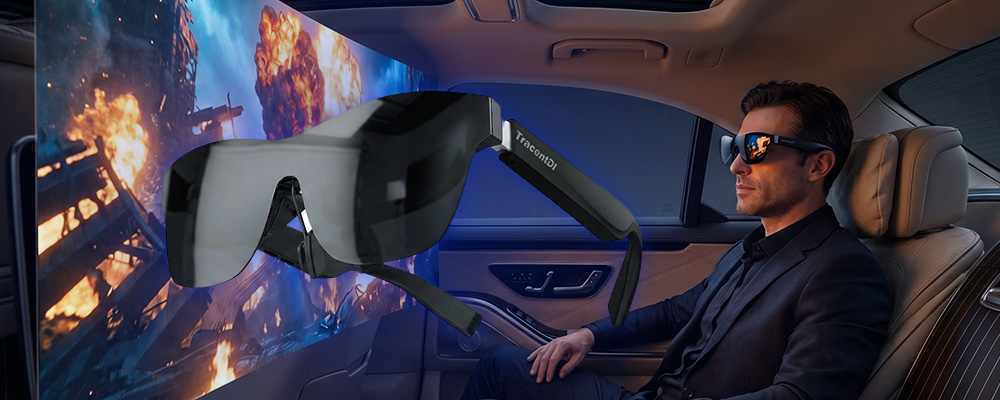
In today’s augmented reality (AR) and smart glasses market, the optical display system is the core variable determining the product’s form factor. It directly influences product form factor, bill of materials (BOM), manufacturing scalability, and ultimately the user experience. For technology brands, product managers, and R&D teams, selecting the right optical architecture at the beginning of a project can have a significant impact on the product’s commercial success.
At present, the industry is largely divided between two mainstream optical approaches: Birdbath and Waveguide. This article examines both technologies from three perspectives—optical principles, application suitability, and supply chain readiness—to provide a practical framework for product selection.
To make an informed choice, it is essential to understand the fundamental differences in optical path design between the two architectures, which directly affect light transmission, device volume, and display performance.
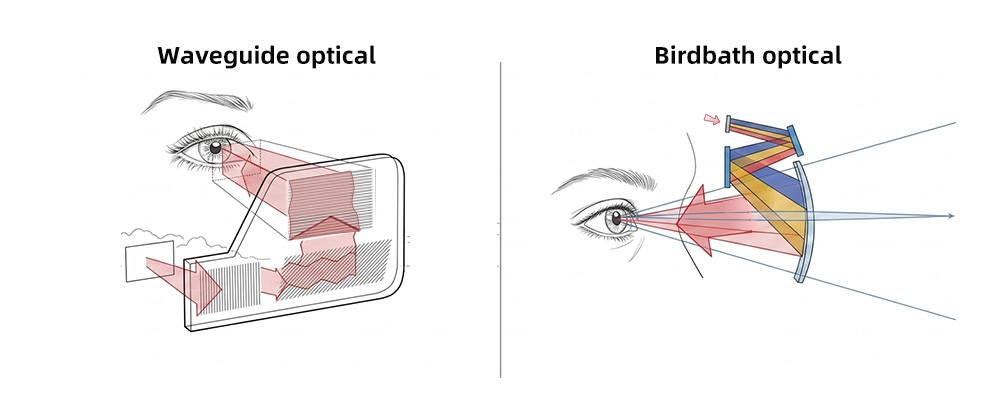
The Birdbath approach uses a classical geometric reflection structure. Its operation involves projecting light from a microdisplay (typically MicroOLED) onto a 45-degree beamsplitter. Part of the light is reflected to a concave combiner, then reflected again through the beamsplitter into the user’s eye. This design has the advantage of a relatively simple optical path, preserving the microdisplay’s color saturation and high contrast. Field of view (FOV) is typically easier to achieve at 45° to 55°. However, because light undergoes multiple reflections and transmissions through the beamsplitter, significant optical loss occurs. To ensure screen visibility, Birdbath glasses often require heavily tinted front lenses, reducing real-world light transmission to around 15–30%. In addition, the optical module’s vertical and depth dimensions make the glasses appear “thicker,” resembling sunglasses, and they difficult to achieve the lightweight profile of everyday eyewear.
Waveguide architectures, by contrast, use total internal reflection (TIR) within a glass or plastic substrate. Light from a microdisplay (such as MicroLED or LCoS) is coupled into the thin lens, where it propagates like in a fiber, reflecting between the lens surfaces before being released through a decoupling structure (geometric array or diffractive grating) into the user’s eye. Waveguides eliminate the need for complex external reflection mirrors, allowing lens thickness to be controlled within 1–2 mm. More importantly, they offer high real-world light transmission (typically over 80%), making the wearer’s eyes visible and supporting the daily form factor expected of consumer-grade glasses. However, waveguides involve highly advanced manufacturing. Diffractive waveguides, in particular, face challenges in optical efficiency and color uniformity, and BOM costs are significantly higher than Birdbath solutions.
Choosing a product solution is not about pursuing the highest technical peak; it is about balancing performance with scenario suitability. Brand and product managers should first define the core use cases.
If the product’s primary selling point is a “pocket cinema,” “portable large-screen office,” or “console gaming companion,” Birdbath is currently the most commercially cost-effective option.
· Visual quality priority: Users in these scenarios demand high color fidelity, resolution, and contrast. Birdbath combined with MicroOLED provides extremely detailed imagery and deep black levels without the edge rainbow or color distortion common in waveguides.
· Ambient light isolation: Viewers and gamers prefer immersive environments. Birdbath’s lower transmission (tinted lens) naturally reduces ambient light interference.
· Static or indoor usage: During movie watching or office work, users are usually stationary, so there is less need for high transparency for social eye contact or mobility safety.
If the product targets “all-day wear,” “smart AI glasses,” or “productivity tools” used frequently outdoors or in social settings, waveguide architecture is required.
· Social acceptability: All-day AR glasses cannot make the wearer appear as if wearing sunglasses. High light transmission ensures eyes remain visible in indoor, meeting, or face-to-face contexts, supporting social norms.
· Environmental safety: Users must perceive all real-world light cues when walking, cycling, or performing industrial inspections. Birdbath’s low transmission poses safety risks in low-light or night environments, while waveguides provide unobstructed real-world visibility.
· High-brightness outdoor readability: Outdoor light levels can reach tens of thousands of lux. Waveguides combined with high-brightness MicroLEDs achieve several thousand nits in-eye brightness, keeping virtual content readable even under direct sunlight.
For procurement and supply chain teams, beyond optical specifications, industrial maturity, production yield, and overall cost are the core determinants of project feasibility.
| Metric | Birdbath | Waveguide (Geometric/Diffractive) |
| Real-world light transmission | Low (15–30%) | Very high (80%+) |
| Color and contrast | Excellent (vivid colors) | Moderate (chromatic dispersion/rainbow effect) |
| Lens thickness | Thick (protruding module) | Thin (1–2 mm, similar to conventional lenses) |
| Supply chain maturity | Very high (mature processes) | Medium (precision machining/nanoimprint) |
| BOM cost | Low to medium | High |
Birdbath’s supply chain is highly mature, using conventional injection molding and coating processes. Production yields are generally high, development cycles are short, and brands can bring products to market quickly and at scale.
Waveguide supply chains are transitioning from technical development to mass production. Geometric waveguides require precise prism cutting, ultra-thin coatings, and alignment, with micron-level accuracy, resulting in longer scale-up cycles. Diffractive waveguides, while theoretically offering lower per-unit cost at scale, require expensive micro- and nanofabrication of master molds and high technical capability to achieve full-color light-efficiency adjustment.
Privacy leakage is another consideration. Birdbath’s open structure allows light to leak forward, making display content visible to others—a potential issue in business or private contexts. Waveguides, by contrast, lock light within the lens via TIR, providing better privacy protection.
When planning an AR smart glasses product line, optical selection should not follow trends blindly:
For consumer-oriented large-screen markets such as media entertainment or light office use, where rapid ROI, predictable display quality, and controlled R&D budgets matter, Birdbath with MicroOLED is the clear choice.
For brands aiming to create all-day AI ecosystems, wearable productivity tools, or high-end fashion-tech items, especially in mid-to-high-end markets, forward-looking investment in waveguide architecture (particularly diffractive waveguide with MicroLED) is warranted, in partnership with precision manufacturing suppliers to optimize yield.
Defining the product’s primary purpose and mapping it to core use cases is the most effective way to maximize supply chain efficiency and commercial value.
As a B2B partner, QQSgroup supports brands through every stage of AR Smart Devices optical evaluation and procurement. Which display architecture aligns best with your upcoming product roadmap?