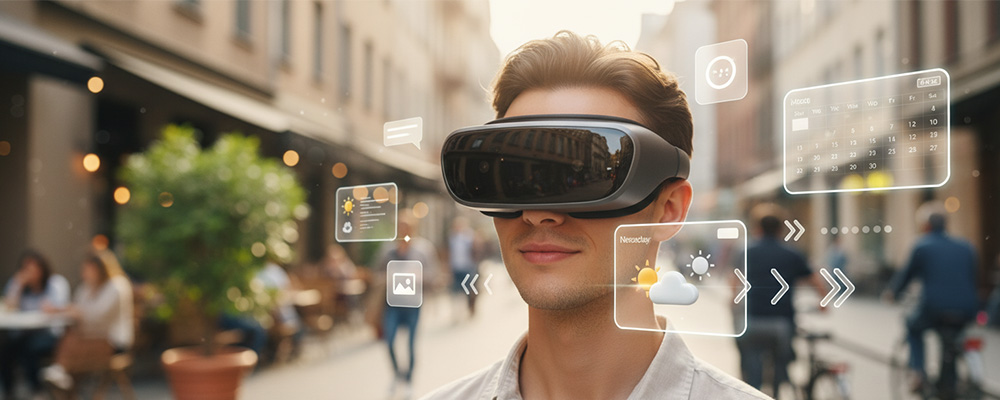
Over the past five years, XR (Extended Reality) technology has moved from laboratory concepts to the mainstream of consumer and industrial applications. From gaming and entertainment to industrial design, education and remote collaboration, XR devices are becoming a core carrier of next-generation human–computer interaction.
According to IDC market insights, global XR headset shipments returned to growth in 2024, with enterprise demand increasing faster than consumer demand. This signals that XR is no longer just a symbol of “future technology”, but is entering a phase of practical industrialisation and mass deployment.
Against this backdrop, understanding XR and its related categories — VR, AR and MR — has become essential for brand owners, product managers and procurement teams planning future smart wearable product lines.
XR stands for Extended Reality, a general term for technologies that blend virtual and real environments. It encompasses Virtual Reality (VR), Augmented Reality (AR) and Mixed Reality (MR). XR aims to extend human sensory perception through visual display, spatial awareness and interactive sensing technologies.
XR Hardware
XR devices typically consist of a display module, sensor systems, a computing unit and an interaction interface. Display modules often use optical lenses with Micro OLED or Micro LED panels. Sensor systems may integrate IMUs, depth cameras, eye-tracking and gesture-recognition modules.
As XR devices move towards lightweight and modular designs, XR hardware manufacturers are focusing on high-integration mainboard layouts, low-power sensor packaging, and customisable head-mounted structural components suited to different application needs.
XR Software
The software layer of XR encompasses the operating system, rendering engine, SLAM (Simultaneous Localisation and Mapping) spatial positioning algorithms, and interactive UI frameworks. The OS manages device operation, while the rendering engine influences immersion and latency. SLAM is essential for tracking user movement in real space, making it a core capability in AR and MR.
The XR software ecosystem is expanding rapidly. From Unity and Unreal engines to XR developer frameworks such as OpenXR, ARCore and ARKit, software tools are providing greater standardisation and compatibility for device makers and solution developers.
What is VR?
VR (Virtual Reality) provides a fully immersive digital experience. By wearing a headset (HMD), the user enters a computer-generated environment, completely isolated from the real world. VR relies on stereo displays and spatial audio to create a complete immersive space.
Typical VR Applications
In consumer markets, VR headsets are widely used for gaming, virtual social experiences and immersive media, such as the Oculus Quest and PICO 4. In industrial and educational sectors, VR is used for assembly training, remote equipment diagnostics and architectural visualisation. VR all-in-one headsets and VR training systems are driving B2B demand and creating consistent ODM/OEM opportunities for manufacturers.
What is AR?
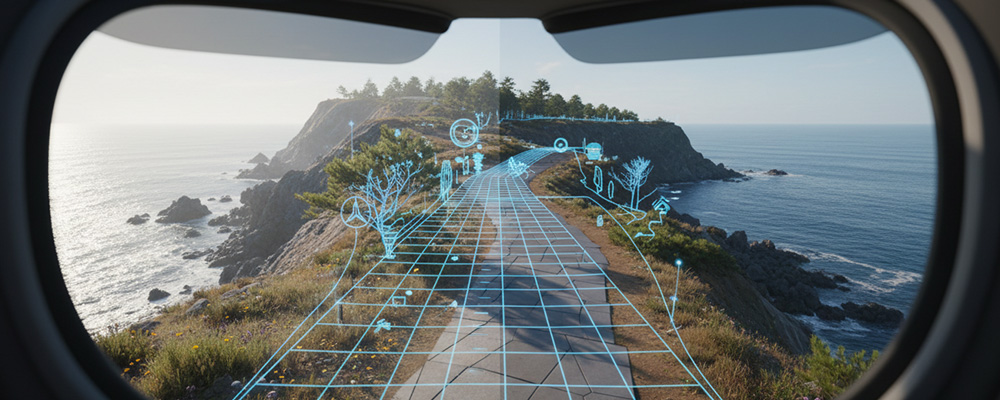
AR (Augmented Reality) overlays digital information onto the real world, allowing the user to see their surroundings while viewing enhanced visual data. Unlike VR, AR does not replace reality — it enhances it.
Consumer AR glasses typically use optical see-through, allowing the user to look through the lens while digital images are projected onto their field of view. In professional and industrial products, video see-through solutions are also used, enabling more precise digital processing, such as accurate occlusion.
Typical AR Applications
AR is used in smart AR glasses, navigation systems, and industrial maintenance solutions. For example, AR glasses can display real-time part information on a production line or assist surgeons during operations. Consumer-level AR products — such as AR running glasses, AR cycling glasses and AR smart fitness glasses — are emerging rapidly, integrating health monitoring, motion data visualisation and intuitive interaction. These applications place high demands on optical waveguide design, heat management and power efficiency.
What is MR?
MR (Mixed Reality) is generally regarded as a more advanced form of AR. Beyond simply overlaying virtual objects, MR enables real-time, realistic interaction between virtual and physical environments.
For instance, when a virtual object is placed on a real table, an MR system recognises the table’s boundaries and depth, allowing the virtual object to be partially occluded and cast shadows appropriately. This level of spatial understanding distinguishes high-end MR devices (such as Microsoft HoloLens) from standard AR devices.
Typical MR Applications
MR was first adopted in engineering design collaboration, remote diagnostics and medical training simulations. Devices such as the HoloLens and Magic Leap are representative examples of these platforms. With stronger computing hardware, MR is expanding into enterprise collaboration, smart manufacturing control systems and spatial data visualisation.
For MR device and XR optical system manufacturers, spatial perception algorithms and multi-sensor fusion remain key development priorities.
XR development is advancing in three directions:
• Lightweight form factors – moving from bulky headsets to glasses-like designs
• Interconnectivity – deeper integration with IoT, cloud computing and AI
• Scenario-based applications – focusing on targeted industry use-cases
For brands and procurement leaders, XR is now a mass-producible, customisable wearable computing platform. As supply chains mature, flexibility in XR hardware manufacturing — from optical engine OEM to full-device ODM — is becoming a competitive advantage.
The next phase of XR growth will be driven not only by innovations in display and interaction, but also by reliable manufacturing, materials engineering and human-centred design. At QQS Group, we specialise in XR devices and smart wearable hardware development and manufacturing, collaborating with global brands to bring products from prototype to mass production. We believe the future of XR lies not only in new display and interaction models, but also in integrating engineering reliability, materials science and human-centred design. Whether it’s next-generation VR headsets, AR eyewear or specialised MR smart hardware solutions, QQS Group is committed to being a trusted technical and manufacturing partner — helping bring “Extended Reality” into real-world reality.